S1, S1P, S2, S3: Meaning and Differences Between Safety Footwear Standards

Slipping, tripping, bumping into obstacles: a professional’s workday constantly exposes their footing to workplace hazards. Whether in warehouses, hospitals, or commercial kitchens, safety footwear is an essential line of defense. However, understanding the language of the European standards that govern this protective barrier between the foot and potential risks is just as important.

This guide breaks down the key safety footwear classifications step by step, making official requirements easier to understand and providing practical guidance for professionals. From the distinctions between S1, S1P, S2, and S3 ratings to additional markings such as SR, WR, and WRU, each section explores regulatory requirements, performance tests, and real-world applications. The goal is to ensure that selecting the right safety footwear goes far beyond aesthetics and is instead based on a thorough assessment of the working environment and its specific risks.

Safety Footwear: EN ISO 20345 Standard and Essential Requirements

The EN ISO 20345 standard defines the fundamental requirements for safety footwear. In particular, it requires a protective toe cap capable of withstanding an impact of 200 joules, helping to protect the foot from crushing injuries. In practical terms, the toe cap is tested using a 20 kg striker dropped from a height of one meter. If the resulting deformation at the front of the shoe exceeds 14 mm, the footwear fails the test. Safety shoes are also subjected to compression, torsion, and repeated impact resistance tests.

The standard further assesses heel energy absorption, resistance to hydrocarbons, material durability, and, depending on the model, antistatic properties. In environments where electrostatic discharge poses a risk, the sole must be capable of safely dissipating electrical charges. EN ISO 20345 therefore serves as the foundation for all safety footwear classifications, including S1, S2, and S3 categories, as well as additional markings such as SR and WRU, which indicate specific protective features.

Understanding S1, S2, S3, S1P, and Other Safety Footwear Ratings: Matching Protection to Workplace Risks

The S1, S1P, S2, and S3 safety footwear ratings can be viewed as a progression of protection levels: each category builds upon the previous one by adding features designed to address increasingly demanding working conditions and workplace hazards.


S1 & S1P: These classifications cover the essential requirements for workplace safety footwear, including a 200 J protective toe cap, a closed heel area, antistatic properties, resistance to hydrocarbons, and heel energy absorption. This level of protection is well suited to indoor environments such as assembly lines, warehouses, and order preparation areas, where floors are generally dry and the risk of puncture is limited.

The S1P rating includes all S1 features while adding a puncture-resistant midsole, made from either steel or composite materials. This enhanced protection is particularly valuable for maintenance technicians and other professionals who may encounter metal shavings, sharp debris, or objects capable of penetrating the sole, providing increased underfoot safety.


S2: This classification incorporates all the requirements of S1 while adding a water-resistant upper, making it particularly well suited to environments where exposure to liquids is common, such as commercial kitchens, food processing facilities, and the catering industry. The upper, often made from full-grain leather, is treated with a water-repellent finish that helps delay moisture penetration while maintaining a high level of comfort, breathability, and flexibility throughout the working day.


S3: This classification combines the water-resistant upper of S2 with the puncture-resistant midsole found in S1P footwear. As a result, it has become the benchmark standard across industries such as logistics, warehousing, and manufacturing. Loading docks, storage areas, wet surfaces, and sharp objects on the ground are all common workplace hazards that S3 footwear is designed to address, offering a versatile level of protection for demanding environments where both moisture resistance and underfoot safety are essential.

Focus on S4, S5, S6, and S7 Standards: Waterproof Safety Boots and Enhanced Protection Levels

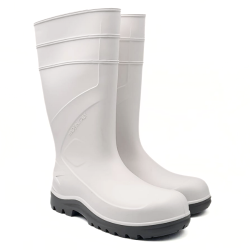
When work involves frequent exposure to water or partial immersion, S4 and S5 safety boots become the preferred choice. Made from injected polymer materials, they provide a 200 J protective toe cap, chemical resistance, and complete waterproof protection, making them particularly suitable for wastewater treatment operators, sanitation workers, and other professionals working in consistently wet environments. Their fully waterproof construction helps keep feet dry throughout the working day while maintaining a high level of safety.

S5 footwear incorporates all the features of S4 while adding a puncture-resistant midsole, offering enhanced protection against sharp objects underfoot. Since the introduction of the updated standards in 2021, the S6 and S7 classifications have further expanded the range of available protection. These categories combine waterproof performance with advanced features such as breathable membranes, improved water resistance, and, depending on the model, thermal insulation for demanding environments. As a result, workers in extreme conditions, such as offshore platforms or cold-weather operations, can benefit from footwear that remains flexible at temperatures as low as −20°C while still providing the same 200 J impact protection required by the EN ISO 20345 standard.

SR, WR, and WRU Markings: How to Choose Slip-Resistant and Waterproof Safety Footwear

A greasy or metallic floor can turn every step into a slipping hazard. This is where the additional markings that complement the main safety footwear standards come into play: SR assesses slip resistance, while WR and WRU indicate different levels of water resistance and waterproofing.

Résistance au glissement : que signifie le marquage SR ?

Until recently, slip resistance was indicated by the SRA, SRB, and SRC markings. SRA assessed grip on soapy ceramic tile surfaces, while SRB referred to testing on a steel surface covered with glycerine. Footwear that successfully passed both tests was awarded the SRC certification.

With the introduction of EN ISO 20345:2022, the SRB classification was removed. Slip resistance on soapy ceramic tiles is now included within the standard’s basic certification requirements, while the SR marking identifies footwear tested on ceramic tile surfaces contaminated with oil. It is now considered the benchmark indicator for environments where the risk of slipping is particularly high.

WR and WRU Waterproofing Ratings: Which Professions Require These Levels of Protection ?

WR certifies complete waterproof protection, with the footwear able to remain immersed for 80 minutes without water penetration. WRU, on the other hand, indicates only a water-resistant upper. Tree surgeons and arborists working in damp grass often choose S3 WR footwear to keep their feet protected from prolonged moisture exposure. By contrast, a pastry chef may only require S2 WRU footwear, which effectively repels syrup splashes while allowing perspiration to escape.

Professionals involved in landscaping and grounds maintenance regularly face morning dew and humid conditions; in many cases, a WRU rating is sufficient to keep the upper dry while maintaining breathability. Sewer workers and wastewater treatment plant operators, however, often work with their feet submerged for extended periods and therefore require the full WR waterproof barrier to prevent prolonged water ingress.

OccupationType of Expodure to MoistureRequired Waterproofing LevelRecommended Footwear StandardWhy?
Sewer Worker/Wastewater Treatment OperatorProlonged partial immersionWR (fully waterproof)S5 WRProtect against continuous water ingress, mud, and chemical agents
Roadworks Technician/Workers in Wet TrenchesDeep puddles, mudWRS3 WR or S5 WRPrevent wet feet and injuries caused by hidden sharp pbjects
Tree Surgeon/ArboristDew, waterlogged grassWRS3 WRKeeps feet dry during prolonged movement on satured ground
Landscaper/GardenerAlternating dew and paved surfacesWRU (water-resistant upper)S3 WRUBlocks surface moisture while allowing the foot to breathe
Pastry Chef/Institutional Catering CookSyrup splashes and sugar waterWRUS2 WRU SRWater-resistant upper + slip-resistant sole for greasy floors
Cold Storage Warehouse WorkerCondensation, cold dropletsWRUS1P WRU SRLight water resistance for intermittent moisture exposure, puncture-resistant sole
Port Worker/Offshore Platform TechnicianSea spray exposureWR (high waterproof protection)S7 WRInsulated and breathable footwea for salty, cold environments
Industrial Cleaning OperativeFloors washed under high pressureWRS2 WR SRPrevent water ingress during cleaning operations, slip-resistant sole

For a complete overview of the standards applicable to professional safety footwear, explore our dedicated guide to the different levels of protection.

Check the inside label of the footwear: the EN ISO 20345 marking should be followed by the relevant classification code, such as S1, S2, or S3, as well as any additional markings such as SR or WR. Without these indications, compliance with the standard cannot be guaranteed.

Steel is thinner but conducts both cold and heat, while composite materials are lighter and do not interfere with security screening systems. Both options comply with the same puncture-resistance standards, providing protection against a force of 1,100 N.

Tests show that after 18 months of intensive use, electrical charge dissipation can decrease by around 20%. Regular checks using a multimeter help ensure that the footwear continues to provide effective antistatic protection throughout its service life.

It is not recommended to wash safety footwear in a washing machine. The combination of heat, water, and drum rotation can damage adhesives, materials, and waterproof membranes, potentially compromising the shoe’s original protective performance. To preserve its original characteristics and extend its service life, manual cleaning is the preferred method.